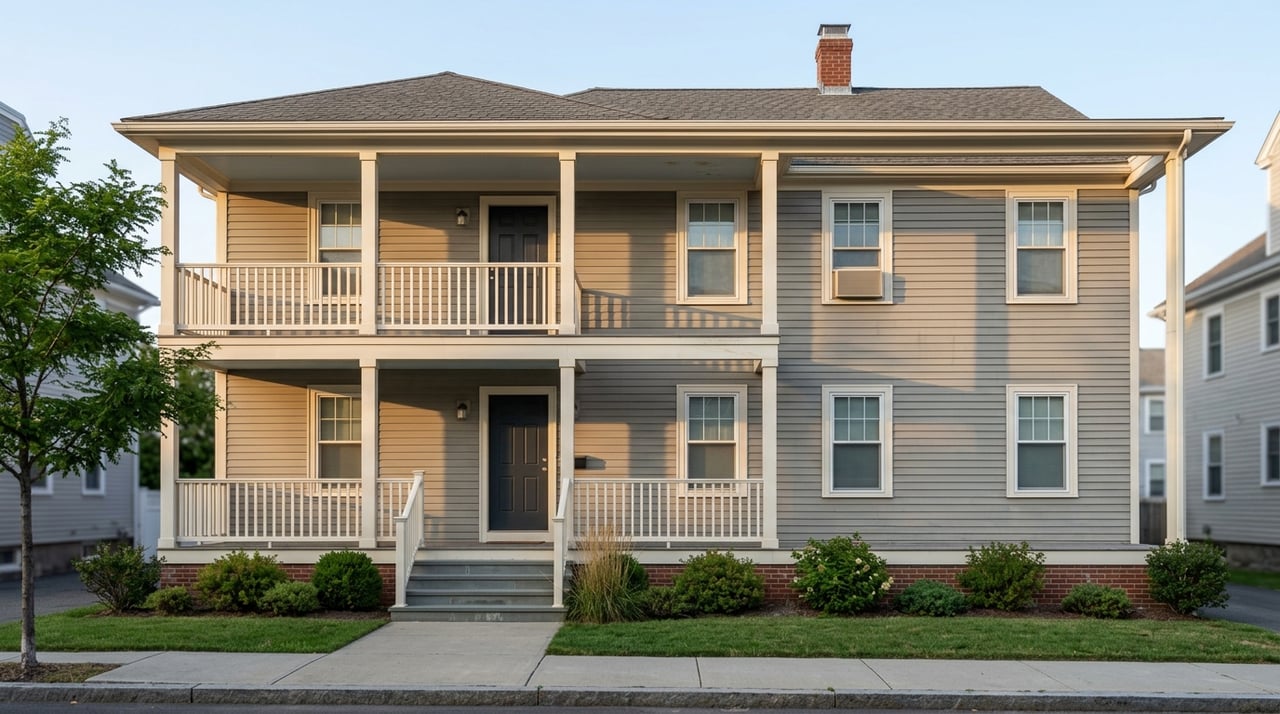
Quincy Multifamily Pricing Strategy for Sellers
If you own a two-family or three-family in Quincy, pricing it like a typical house can cost you real money. Small multi-family properties sit in a different lane because buyers often look at both the building itself and the income it can produce. If you want to price your property with more confidence, this guide will show you what matters most in Quincy right now and how to position your building for the strongest result. Let’s dive in.
Quincy’s broader housing market is strong, but multi-family sellers should be careful about leaning too heavily on the citywide median home price. In the 2020 to 2024 ACS, Quincy had a 45.2% owner-occupied housing rate, a median gross rent of $2,118, and a median owner-occupied home value of $618,500. Those numbers help set the backdrop, but they do not tell the full story for a two-family or three-family sale.
Recent market data shows a clear gap between Quincy’s overall housing market and its multi-family segment. Redfin reported a median sale price of $610,000 in March 2026 for Quincy homes overall, with about 20 days on market and roughly 3 offers per home. By comparison, Quincy multi-family listings showed 18 active listings with a median listing price of $950,000 and a typical market time of 24 days.
That difference matters because small multi-family buyers are often comparing income potential, building condition, and future expenses, not just bedroom count or square footage. A pricing strategy that works for a single-family home may miss how investors and owner-occupants evaluate a rental property. In other words, your best price is usually built from the right comp set and the right income story.
Recent Quincy sales show how wide the pricing range can be for similar property types. That range is one reason strategic pricing matters so much.
Here are a few notable sales from the local market:
These sales suggest that well-kept or renovated two-families can trade around or above the mid-$1.1 million range, while properties needing work may sell closer to the low-to-mid $900,000s. Sellers should also know that Quincy Assessors publishes 2024 calendar year sales reports for two-family and three-family properties. That can be useful because it reflects the same public sales sets the assessor may review.
For a Quincy two-family or three-family, buyers often test value through income, not just through price per square foot. Massachusetts appraisal guidance describes capitalization rate as the relationship between net operating income and market value, and as the return an investor expects from a specific property. State guidance also says the income approach should be supported by rental information, vacancy rates, expense data, and a proper income-capitalization analysis.
That means your asking price should be able to hold up when a buyer reviews the building’s numbers. If the property looks overpriced once income and expenses are applied, sophisticated buyers may hesitate even if the building presents well online. This is especially true for investors who want a defensible path from rent to value.
For sellers, that creates a simple takeaway: your rent roll matters. Appraisal guidance supports gathering a current rent roll and, when possible, a three-year history of rents. Massachusetts loan-package guidance also calls for a current rent roll and the last three years of cash flow, income, expenses, and capital-repair data.
The more organized your records are, the easier it is for a buyer to trust your pricing. Clean documentation can make your property feel lower risk, which can support stronger offers.
Before listing, it helps to have:
Quincy rent data also provides helpful context, though it should not replace your actual building numbers. Zillow’s Quincy rent page showed an average rent of $2,547, with a one-bedroom average of $2,198. Trulia showed roughly $2,200 for one-bedroom units and $2,611 for two-bedroom units.
Those market averages can help frame buyer expectations, but they do not carry the same weight as your real rent roll. A buyer will usually care more about what your units actually produce today and whether those rents appear stable and supportable.
Condition plays a major role in how buyers price risk. In Quincy, the local sales examples suggest that updated buildings with features like modern kitchens, newer systems, separate utilities, decks, or parking can command materially stronger prices than similar buildings that need work.
That price gap is not just about appearance. Buyers often connect condition with future repair costs, downtime between tenants, reserve needs, and how quickly they can move forward after closing. A building that feels turnkey often attracts more confidence than one that comes with a long to-do list.
If you are getting ready to sell, focus on improvements that clarify value and reduce buyer doubt. For many Quincy multi-family properties, that may mean highlighting system updates, utility separation, parking, outdoor space, and any improvements that support livability or lower maintenance risk.
If your building was built before 1978, lead paint status can shape both pricing and negotiation. Massachusetts requires sellers and real estate agents to provide the Property Transfer Lead Paint Notification before signing a purchase-and-sale agreement. The state also notes that homes built before 1978 may contain lead.
If a child under 6 will live in the home, the owner must have the property deleaded or brought into interim control within 90 days of taking title. Because Massachusetts maintains public lead-history resources, buyers may review compliance history as part of their diligence. For sellers, this means lead status can influence contingencies, buyer comfort, and the strength of the final offer.
Property taxes are not just a side note in a multi-family sale. They are a real input in how buyers underwrite the building.
Quincy’s 2026 residential tax rate is $11.78 per $1,000 of assessed value. At a $1,000,000 residential assessment, that works out to about $11,780 per year in city property tax. For an investor, that annual carrying cost affects projected returns. For an owner-occupant, it affects monthly affordability.
Quincy has also adopted an MBTA Community Multi-Family Overlay District in North Quincy and West Quincy, covering about 161 acres. The city ordinance states that the district allows multi-family housing as of right under Section 3A of the Zoning Act. The state MBTA Communities law requires eligible communities to zone for multi-family housing in at least one district of reasonable size.
For a current seller, that does not automatically change the value of an existing two-family or three-family. Still, it is reasonable to think that transit-adjacent properties may be viewed in the context of future housing supply. Buyers may weigh that future competition differently depending on location, condition, and how unique your property is in today’s market.
One of the biggest mistakes sellers make is assuming every buyer sees the property the same way. In Quincy, your likely buyer pool may include both investors and owner-occupants, and those groups often value the same building differently.
Fannie Mae rental-income guidance shows that owner-occupant buyers of 2- to 4-unit properties may be able to use rental income from non-owner units when qualifying. That can make these buyers more sensitive to layout, livability, and move-in condition, because they are not looking only at net operating income. An investor may focus more tightly on stabilized income, expenses, and expected return.
This is why strategic pricing is not just about reaching the highest possible number. It is about choosing a number that makes sense to more than one buyer type, especially if your building has features that appeal to both camps.
A strong list price usually starts with recent Quincy two-family and three-family comparables, then adjusts for condition, rents, expenses, and buyer demand. Massachusetts CMA guidance says similar properties should be compared by features such as bathrooms, bedrooms, age, style, condition, and lot size, with the appropriate capitalization rate applied to net operating income.
In practical terms, a defensible list price should answer a few key questions:
If the price works on paper and in person, you are in a much stronger position. If it only works as an aspirational number, buyers may push back quickly.
Once offers come in, the highest headline price is not always the best outcome. A clean, credible offer can be more valuable than a slightly higher one with weak assumptions or heavier risk.
A smart offer review framework includes:
This is where experienced positioning and negotiation can matter. The right pricing strategy should help you attract serious buyers, reduce avoidable friction, and improve the odds that your deal actually closes near the agreed terms.
In Quincy, the best list price for a small multi-family is usually not the most optimistic number. It is the number that can be supported by recent local sales, a credible rent roll, realistic expenses, and condition-based adjustments that make sense to today’s buyers.
That kind of pricing does more than create interest. It helps your property feel believable, financeable, and worth pursuing. If you are preparing to sell a Quincy two-family or three-family, a disciplined pricing plan can protect your leverage from day one.
If you want help evaluating your Quincy multi-family through both a seller and investor lens, Matthew Langlois offers market-aware pricing guidance, professional listing marketing, and direct support from consultation through closing.
From start to finish, Matthew will be your advocate, ensuring a smooth transaction that fits your timeline. He has a genuine love for what he does and takes pride in helping his clients achieve their goals.